

Forela brings the whole story into endometriosis care.
Daily support for women, connected thinking for clinicians, and a story that carries from one appointment to the next.
Why complex care breaks down
Endometriosis and conditions that travel with it can affect more than the pelvis. Symptoms cross specialties, but care often happens one visit at a time.
Women carry the changes between appointments. Clinicians have to connect them with the history, often within the time of a single visit. Each appointment can go well, and the thread of care can still be lost.
What's missing is a way to carry the whole story forward as symptoms, treatments and daily life change.
How Forela is different
Forela brings the thinking of a multidisciplinary care team into daily life and clinical care.
For women, that means a daily plan across meals, movement, mental health and sleep, shaped around your goals and the time you have. It's also a place to ask questions about what you are experiencing, with guidance grounded in clinical protocols against your case, not someone else's.
For clinicians, it brings the thinking of different specialties together around the patient's history, symptoms and everyday changes: what the case supports, what is still missing, and what to ask next.
Forela is designed to connect daily support and clinical thinking around the same patient story.
Forela exists to close the gaps that leave women waiting for answers and care. We bring women's daily experience and the thinking of a multidisciplinary care team together, so the whole story can shape what happens next. The information behind an answer should be visible, uncertainty should be clear, and care should remain in the hands of women and their clinicians.
What Forela makes possible
Support for your day, clearer thinking for your care, and continuity between the two.
For Women
Would your life look different if your symptoms were taken seriously?
Your history matters, and so does the day you're having. Forela brings both into view, with support you can use now and a record that connects with your care team, with your permission.
What you get:
- A daily plan shaped around your goals and the time you have
- A place to capture symptoms and how your day actually felt
- A view of what is changing against your own usual pattern
- A history that flows into your care, with your permission, so you have less to reconstruct from memory
For life with endometriosis and conditions that travel with it, between visits and as care moves forward.
Download Forela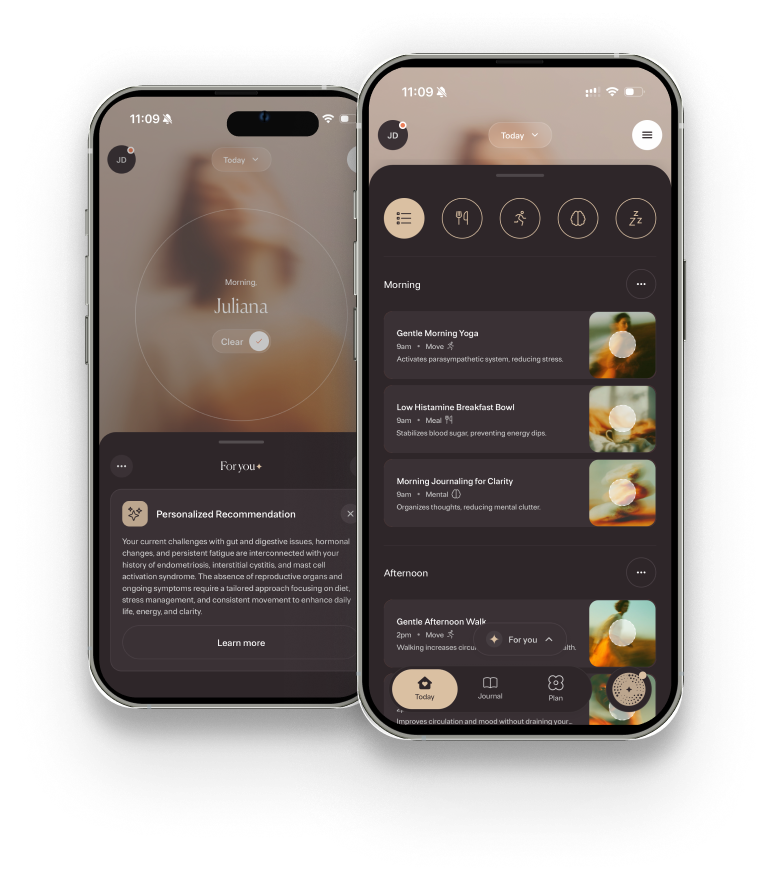
For Clinicians
Endometriosis and conditions that travel with it rarely fit within one specialty. You have the clinical history, the patient's account, and changes that may cross pelvic, gut and other systems.
Forela brings the thinking of a multidisciplinary care team to the case. It reasons across specialties together, connecting the patient's history, symptoms and treatment response to help you find the next step, rather than leaving you to reconcile separate opinions.
What you get:
- A view of what changed since the last visit, read against the patient's own baseline
- A connected reading of symptoms, treatment timing and response
- The patient information and clinical sources behind the reasoning
- The missing evidence that could change the picture, and the next question to ask
Help shape Forela's clinician product.
We're inviting clinicians to take part in validation and help test how this reasoning fits real clinical work.
Get in touch about validationFor Platforms
Bring connected thinking into the care experience you offer.
Forela reasons across specialties to reach a connected understanding of the case, starting with endometriosis and conditions that travel with it. That thinking can support both the women using your platform and the clinicians caring for them.
Explore how Forela could add:
- Daily support shaped around each woman's goals and circumstances
- Clinical reasoning across symptoms, history and treatment response
- A clearer view of missing information and the next question to ask
Talk with us about the capabilities your platform needs and how Forela could fit.
Talk to our teamWhere We Start
Bringing connected thinking to complex care
We start with endometriosis and conditions that travel with it, where symptoms can cross systems and care can lose its thread between specialists. It is our first focus for testing connected reasoning around the individual patient.
Our first validation focus and future areas of exploration
Pelvic-Gut | In validation
Endometriosis, adenomyosis, IC/painful bladder syndrome, IBS and SIBO
Our first focus is understanding cases where pelvic and gut symptoms overlap.
Barrier-Immune | Future exploration
IBD, celiac disease and Hashimoto's
Gut-Organ | Future exploration
Psoriasis, psoriatic arthritis, autoimmune hepatitis and type 1 diabetes
Neuro-Immune | Future exploration
Fibromyalgia and POTS
Recognition
TechCrunch Disrupt 2026, San Francisco, October 13 to 15. Women's Venture Summit, San Diego, November 2 to 5. HLTH 2026, Las Vegas, November 15.




Support for the days between appointments
Start with your story. Build a plan for the day you're having.